The Garage

The stories are legendary – of great tech companies from HP to Google starting in garages.

CALI didn’t exactly get its start in a garage, but I do I like to think of CALI’s booth at AALS as the “garage” for CALI lessons. It’s where CALI’s staff gathers to talk with faculty members, current authors and future authors. And, AALS in Washington, D.C. at the beginning of January was no different than past years.  The conversations ranged from using CALI lessons in courses, free casebooks and statutory supplements from eLangdell Press, Classcaster, authoring lessons and constructing the most awesome mini-figs.

I left AALS with a pocketful of business cards from faculty members interested in authoring for CALI. Some faculty are interested in authoring lessons in existing areas to expand our coverage in those areas. Others are interested in striking out into new territory: Elder Law and Immigration, for example. Lessons in these areas are in addition to conversations that I’d already had in late Fall with several faculty members interested in writing in the areas of Aviation Law and Native American Law.

What does this mean for law students and faculty? More lessons. We’re on track to hit 900 lessons by the CALI Conference in June. Assuming each lesson is about 45 minutes in length, we are quickly approaching over 650 hours of educational materials. This is far more hours of CALI lessons than any one student should use, and we’re working to improve the ways that students and faculty find the “best” lessons for them to maximize students’ time and needs. We’ve got subject outlines and casebook correlation tables. Over the next seven months, we’ll be adding links to more lessons and more casebooks.

This week CALI is selecting a team of faculty to become the Administrative Law Fellows. We received many applications from very qualified faculty and spent most of last week interviewing them. The decisions have been difficult. Very difficult. And, by next week, we should have assembled a remarkable team of faculty. Within two months, I’ll see their first drafts.

Including this new group of Administrative Law Fellows, I’m working with about 20 faculty. I anticipate they will author more than 70 lessons in the next 12 months. My colleague, Sarah Glassmeyer, is working with about the same number of law librarians on legal research lessons. We’re projecting just short of 100 lessons in the next year. It’s all very exciting!

We’re always looking for more authors. Contact us if you’re interested in writing a lesson. Let us know which casebook you use, so we’re certain to try and include it in our correlation tables. And, next year at AALS, please stop by CALI’s “garage.” “Kick the tires” on our newest projects and talk with us.


Credit: Artwork by Eric Molisnky for CALI – flickr.com/caliorg

Share
Posted in CALI Spotlight | Tagged , | Comments Off on The Garage

Free, Online Course on Digital Law Practice

Because of technological, economic, and market pressures, the way we practice law is rapidly evolving. Law students, are you prepared for these changes in law practice? Legal educators, are you preparing your students? CALI is offering a free nine-week online course on Topics in Digital Law Practice to help address these issues starting Friday, February 10, 2012 at 2pm ET. The course is open to anyone.

Register here.

About the Course

This course is designed to provide an overview of Continue reading

Share
Posted in CALI Announcements, CALI Spotlight | Tagged , , | 4 Comments

The Enhanced Book

I have a box of tissues on my desk that’s decorated like a bookshelf. My mother jokingly gave it to me when I started at CALI just in case I started to miss being surrounded by books all day. The thing is, though, I’m still surrounded by books all day. They just all happened to exist digitally within the confines of the computers here at CALI World Headquarters.

Wait wait wait. Hold it right there, Skippy. I know what you’re thinking.  But this isn’t a print vs. digital blog post.  If it were, I could bring out the usual arguments. Some classic examples:

Pro-Print:

  • DRM free – important for ownership, resale and lending.
  • That print book feel and smell.
  • Doesn’t require initial purchase of technology that may be soon be obsolete – print lasts 100 + years
  • Can be thrown across the room when you disagree with author’s plot choice. (Oh, like I’m the only one that does that.)

Pro-Ebook Continue reading

Share
Posted in CALI Spotlight | Tagged , , | Comments Off on The Enhanced Book

New Way to Print Lesson Score Certificates

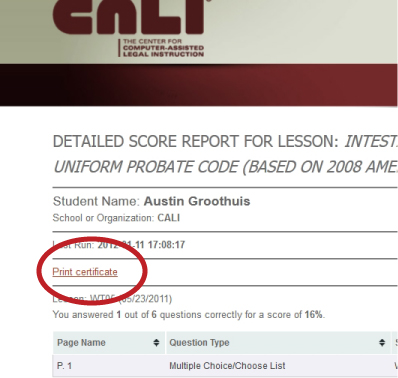
Print a score certificate

Another new CALI Lesson feature: print a score certificate outside of a lesson at cali.org, even after the lesson has been finalized.

Login to cali.org and click “My Lesson Runs.” Click the score% of the lesson you’d like to print. You’ll find the the “Print Certificate” link (shown here) above the detailed lesson scoring report.

This FAQ explains printing from within a lesson.

Share
Posted in CALI Announcements, CALI Spotlight | Tagged , , | Comments Off on New Way to Print Lesson Score Certificates

New! Exit a CALI Lesson, resume it later.

CALI Lessons: Exit & ResumeWe start the Spring semester with a surprise new feature for CALI Lesson users: lesson resume. Here’s a quick tour:

  • The resume feature is automatic. If you leave a lesson by any means such as closing the browser or turning off the computer, you’ll be able to resume later…that is, unless you complete and finalize (more on that below).
  • There’s an “Exit & Resume Later” link in the upper right that ensures you’ve left the lesson with the ability to resume.
  • To resume a lesson in the same spot with the same score, login to cali.org and click “My Lesson Runs in the right hand menu.
  • When you get to the end of a lesson, you’ll be given the option to complete and finalize your lesson. If you take this option, you cannot resume that lesson. You can, of course, run the same lesson again from the beginning. There’s also a “Complete the Lesson” link in the table of contents if you’d like to finalize your score prior to hitting the final screen.

Here’s a more detailed FAQ on the new CALI Lesson resume feature.

Continue reading

Share
Posted in CALI Announcements, CALI Spotlight | Tagged , , , | Comments Off on New! Exit a CALI Lesson, resume it later.

Coming to AALS? Join us for CALI’s annual member meeting.

If you’re attending the AALS Annual Meeting in Washington, DC, join us Friday morning for breakfast and a brief presentation about CALI’s work in electronic casebooks, new online teaching tools, technology to integrate practice into teaching, and other innovations in legal education and access to justice.

Friday, January 6, 2012, 7:15 -8:30 am
Marriott Balcony B, Mezzanine Level
Marriott Wardman Park Hotel

To reserve your place at the breakfast, please RSVP by December 28, 2011.

You are welcome to invite your law school colleagues who would like to learn more about CALI. If you have any questions, you may contact LaVonne Molde at Lvmolde@cali.org or 612-627-4908.

Share
Posted in CALI Announcements, CALI Spotlight | Tagged , , | Comments Off on Coming to AALS? Join us for CALI’s annual member meeting.

Your CALIcon12 Theme is…

CALIcon12 Logo

I bet the overlap between CALI Conference attendees and those who played with Leg…

Wait. Oh, hi Deb, CALI General Counsel and colleague with whom I share an office wall.

What? Oh, I mean. Uh, ok…send me the phrase and I’ll copy and paste it.

I bet the overlap between CALI Conference attendees and those who played with generic interlocking building block toys as kids is pretty remarkable. The Venn diagram is probably just a little circle inside a big circle if you limit the field to those of us who Continue reading

Share
Posted in CALI Announcements, CALI Spotlight | Tagged , , | Comments Off on Your CALIcon12 Theme is…

CALI Supports Colorado Public Domain Citation Proposal


Recently, the Colorado Supreme Court posted a proposal for adding public domain citations to Colorado case law. As part of the proposal, they asked for comments from the public. CALI submitted a response – which includes some suggestions for changes to the proposal – that appears below.

Why do we care about public domain citation in Colorado? The answer is two-fold. One, we’re selfish. Public domain/vendor neutral/media neutral citation formats are a first step in making law open and accessible. The more open and accessible law becomes, the easier it is for us to create CC licensed educational products for our member community. I have a domino theory of Open Law…each time a jurisdiction makes a step towards opening up their legal materials, the more likely it is that some other state will look to them and say, “Well, if Colorado can do it, we can and should too.”

Secondly, CALI works with organizations like the Legal Services Corporation (aka the people that fund Legal Aid organizations) and Chicago-Kent’s Center for Access to Justice & Technology to develop technological solutions to the issues involved with helping the public and increase access to justice. One such solution is our A2J software which helps legal aid attorneys create computer-based, self-guided A2J interviews for use by unrepresented litigants and others in need. The A2J interviews walk users through a step-by-step question and answer process, which, in the end, creates a legal form. Open law is another piece in the Access to Justice puzzle; Justice cannot happen when people are prevented from obtaining legal information. We believe that an individual’s ability to access the law that governs them should not be dependent on their ability – economic or otherwise – to use commercial products. The law should be free and open and readily available. Courts can put up all the PDFs of case law that they want…but if a litigant is required to still cite to the regional reporter citation, they are tied to the commercial publications.

Oh, enough of my ranting…..Here’s the text of the letter Continue reading

Share
Posted in CALI Spotlight | Tagged , , | Comments Off on CALI Supports Colorado Public Domain Citation Proposal

Lessons by Casebook

The air is getting crisp, Starbucks changed from their white to red cups and law students are running around in a frenzy trying to get ready for their fall finals.  Yes, it truly is  the most wonderful time of the year.

As John mentioned in the inaugural post to this blog, we have a “Project Idea Bucket” where we keep a running list of projects we’d like to work on or new ways to assist our members.  I had a really good one (if I do say so myself) a few weeks ago…I thought it’d be great if we could key our lessons into casebooks so that when students were reviewing for finals, they would know exactly which lesson would go with their class notes.  I mentioned this to John and he agreed that it was a good idea.  So good, in fact, that CALI has been doing this for a few years now.

Oops.

So, if you are a law student (or someone that works with them), check out the Lessons by Casebook chart we maintain on the website.   It might make your finals prep just a little easier.


Image credit: http://www.flickr.com/photos/johncohen/

Share
Posted in CALI Spotlight | Tagged , , | 1 Comment

OER: Where Law School Lags Behind K-12 and Undergrad

Open Education Conference LogoI recently had the opportunity to attend the 8th annual Open Education Conference in Utah along with CALI’s Executive Director, John Mayer. The conference brought together educators, administrators, and technologists from the K-12 and post-secondary worlds to share information, show off projects, and discuss the current and future state of Open Educational Resources. Wikipedia defines Open Educational Resources (OER) as:

digital materials that can be re-used for teaching, learning, research and more, made available for free through open licenses, which allow uses of the materials that would not be easily permitted under copyright alone.[1] As a mode for content creation and sharing, OER alone cannot award degrees nor provide academic or administrative support to students.[2][3] However, OER materials are beginning to get integrated into open and distance education.[4] Some OER producers have involved themselves in social media to increase their content visibility and reputation.[5]

I attended sessions, participated in discussions, and met interesting people. From all of this I came away with a few things that I think are important to CALI and the future of OER in law schools. Continue reading

Share
Posted in CALI Spotlight | Tagged , , , , , , , , | 1 Comment